
Quick Filters:
ToggleThe way apps are built has fundamentally changed. In 2026, you no longer need a full engineering team to turn an idea into a working product. With no-code AI app builders, a single founder can go from concept to MVP in hours, not months.
But here’s the truth most people miss:
There is no perfect tool, only the right tool for your stage.
Some tools are optimized for speed. Others for flexibility. Some for non-technical founders, and others for builders who think like engineers.
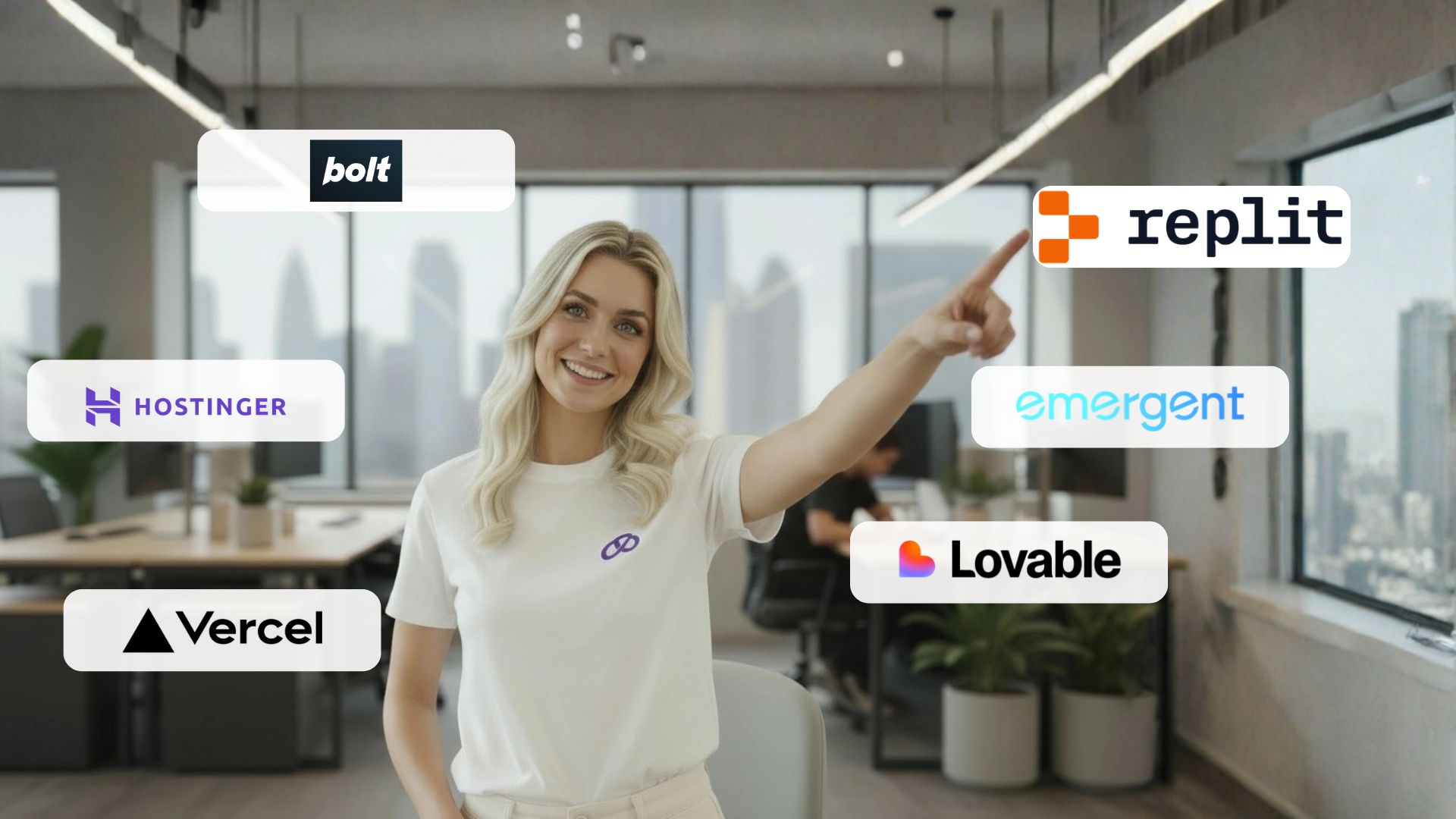
In this guide, we’ll break down the 6 best no-code AI app building tools in 2026, based on real industry feedback, builder experiences, and practical use cases.
Quick Filters:
Toggle1. Replit, The Most Flexible AI Development Environment
Replit has evolved from a browser-based IDE into one of the most powerful AI-assisted development environments available today.
What makes Replit stand out is its flexibility. Unlike many no-code tools that restrict you to predefined structures, Replit gives you a more open environment where AI helps you build, but doesn’t lock you in.
Why it stands out
Supports real coding + AI-assisted generation
Works for both prototypes and advanced apps
Allows deeper customization compared to most tools
What to consider
Replit shines when you know what you’re building. If you use its AI agent without clear instructions, it can consume credits quickly. Similarly, while it’s great for MVPs, moving into production requires you to think about architecture, scaling, and database structure yourself.
Best for
Founders who want control
Builders with some technical thinking
Projects that may evolve beyond MVP
Positioning: Replit is not the easiest tool, but it’s one of the most powerful if used correctly.
2. Lovable, The Fastest Way to Validate an Idea
Lovable is designed for one thing: speed.
If your goal is to turn an idea into a visible product, landing page, dashboard, or simple SaaS interface, Lovable is one of the fastest tools available.
Why it stands out
Extremely beginner-friendly
Generates clean UI and simple flows quickly
Great for idea validation and early demos
What to consider
Lovable is frontend-first. While it helps you build quickly, the backend layer is relatively shallow. As your product grows, you’ll need to define your own architecture outside the tool.
Best for
Non-technical founders
Early-stage MVPs
Rapid validation before investing heavily
Positioning: Lovable is not built for scaling — it’s built for proving your idea fast.
3. Emergent, The Closest to Real Engineering (Without Coding)
Emergent sits between no-code simplicity and real engineering structure.
Compared to tools like Lovable, it operates with a more engineering-oriented mindset, making it better suited for builders who want more control over logic, workflows, and backend behavior.
Why it stands out
Stronger backend and automation capabilities
Better structure for growing applications
Smoother transition from MVP to production
What to consider
There’s a slightly higher learning curve. Emergent expects you to think more like a builder, not just a user clicking buttons.
Best for
Founders building serious SaaS products
Users comfortable with logic and systems
Projects that will scale beyond MVP
Positioning: Emergent is where no-code starts to feel like real software development.
4. Bolt.new, The Fastest Full-Stack AI Builder
Bolt.new is one of the most impressive tools in terms of raw speed.
You can go from a prompt to a working full-stack application in minutes. It’s one of the closest things we have today to “idea → product instantly.”
Why it stands out
Extremely fast full-stack generation
Prompt-driven development
Code export capability
What to consider
Speed comes with tradeoffs. Token usage can increase quickly, especially when refining UI or iterating. Also, since the tool is evolving rapidly, preview environments can occasionally feel unstable on larger builds.
Best for
Fast iteration
Hackathons and rapid experiments
Builders who want instant results
Positioning: Bolt.new is speed-first, perfect when execution time matters more than perfection.
5. Hostinger Horizons, The Best All-in-One Beginner Platform
Hostinger Horizons takes a different approach: simplicity through integration.
Instead of combining multiple tools, it offers hosting, backend, authentication, and deployment in one place.
Why it stands out
All-in-one ecosystem
Beginner-friendly setup
Lower cost compared to many competitors
What to consider
The platform is more controlled. This means less flexibility compared to tools like Replit or Emergent. For more advanced use cases, you may need to integrate external services manually.
Best for
Beginners starting from zero
Simple applications
Founders who want minimal setup
Positioning: Horizons trades flexibility for simplicity, and for many beginners, that’s exactly what they need.
6. Vercel (v0), The Best AI UI Generator
Vercel’s v0 is not a full app builder, and that’s exactly why it’s powerful.
It focuses on one thing: generating high-quality frontend components.
Why it stands out
Produces clean, production-ready React components
Excellent UI/UX output
Perfect integration with modern frontend stacks
What to consider
v0 is not a full-stack tool. You’ll need to handle backend, database, and logic separately. This makes it more suitable for developers or teams with technical capabilities.
Best for
Frontend development
Developers building UI fast
Teams with existing backend infrastructure
Positioning: Vercel v0 is a specialist — the best at UI, but not a complete solution alone.
What Builders Agree On
Across real user discussions and builder experiences, one pattern is clear:
Lovable and Horizons are the easiest for beginners
Bolt and Emergent are the strongest for builders
Replit is the most flexible but requires discipline
Vercel v0 delivers the best UI but is not a full product builder
This isn’t about which tool is better.
It’s about which tool matches your current stage.
Which Tool Should You Choose?
Here’s a simple decision framework:
If you have no technical background
Start with Lovable or Hostinger Horizons
If you want to validate an idea fast
Use Lovable or Bolt.new
If you want to build a real SaaS product
Choose Emergent or Replit
If you care about UI quality
Use Vercel v0 alongside another tool
Building Is Easy, Getting Discovered Is the Real Challenge
Building an app is no longer the hard part, distribution is. In the past, launching a product required months of development, but today, anyone can build an app in hours using AI tools. The real challenge now is getting discovered. Your potential customers are no longer just searching on Google; they are asking tools like ChatGPT, Gemini, and other AI systems for recommendations. If your product is visible in ChatGPT, it effectively does not exist. This is where AI Rank Checker becomes critical for AI SEO. Instead of guessing your visibility, you can track exactly where your product stands in AI search results and optimize accordingly. Because in 2026, the winners are not the ones who build, but the ones who get seen.
Final Thoughts
No-code AI tools are not replacing developers, they are amplifying builders.
The biggest mistake founders make is choosing a tool based on hype instead of fit.
Remember:
Speed matters in the beginning
Structure matters as you grow
Flexibility matters at scale
The best founders in 2026 are not the ones who use the most powerful tools.
They are the ones who use the right tool at the right time.
And that’s the real advantage in the age of AI.